About Hex Match
Six sides change everything. Hex Match takes the match-and-clear idea off the square grid and onto a honeycomb of hexagons, where tiles connect in six directions instead of four. Group matching colours, clear them away, and keep the board flowing. It is a free puzzle game you can open in a click, and its hexagonal twist gives a familiar loop a genuinely fresh feel.
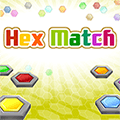
The board runs as an HTML5 game, so the honeycomb grid and every clear render in your browser tab on desktop or mobile — no download and nothing to install.
What is Hex Match?
It is a colour-matching puzzle played on a grid of hexagons. Instead of the usual up-down-left-right, each tile borders six neighbours, so matches and clusters form in more directions. Depending on the version, you clear tiles by grouping three or more of a colour, swapping neighbours to line them up, or placing hex pieces to complete lines. Matched tiles clear and the board settles, often triggering a cascade. That extra connectivity is what sets this browser game apart from a standard square matcher — there are simply more ways for tiles to link.
What keeps it engaging is thinking in six directions. A cluster that looks isolated on a square grid often connects around the honeycomb, so the sharpest players learn to read the hexagonal lines that a square-grid instinct misses. Spotting those angled connections, and setting up the cascades they unlock, is the skill this online game builds.
Where to play
You can play this online game on desktop, laptop, tablet, or phone. On a computer you click or drag tiles; on touchscreens you tap and swipe. Because it is a light HTML5 game, it loads instantly and stays smooth on any device, with no download before the first board.
How to play
Your goal is to clear tiles by matching colours across the hex grid, usually to meet a score target or objective. You group or line up three or more of the same colour, they clear, and the board reacts — dropping or refilling tiles depending on the version. Larger groups and chain reactions score more. Clear the goal and you advance to a tougher board. There is no long tutorial — a board or two teaches the loop, exactly what a good free puzzle game should do.
| Device | Match tiles | Extra |
|---|---|---|
| Desktop / Laptop | Click or drag to group matching hexes | Six-way neighbours count as adjacent |
| Mobile / Tablet | Tap or swipe to line up a match | Watch for angled connections |
| All devices | Bigger groups and cascades score more than small clears | |
Scoring and progression
Larger matches and chain cascades score higher than minimum clears, and some builds reward clearing a board efficiently. Early boards are open with few colours; later ones add colours, obstacles, or tighter targets, so reading the hex lines matters more. In most versions your score climbs with every clear, and finishing a board with resources to spare beats scraping through.
Core mechanics
Think in six directions. When you scan for matches, remember each hex touches six neighbours. A colour you would dismiss on a square grid often connects diagonally around the honeycomb, so check every adjacent side before moving on.
Chase cascades. When a clear lets tiles settle into new positions, fresh matches can form automatically. Spotting a clear that sets up a collapse pays out several groups from one move.
Target the objective. When a board asks for a colour or a cleared obstacle, aim your matches there. Chasing flashy groups elsewhere wastes moves on a target-driven board.
Keep the board open. When you have a choice, favour clears that free the most crowded area. Thinning a packed corner keeps the whole board flowing rather than letting one region clog.
Tactics for a bigger score
Hunt the largest cluster. Before you commit a move, look for the biggest connectable group of a colour across the hex lines. Clearing it scores best and frees the most space, and on a honeycomb those groups are often larger than they first appear.
Build for chains, not singles. A minimum match clears little. Setting up a clear that drops tiles into further matches multiplies your score, so hold a move for a moment if it creates a cascade rather than a lone group.
Learn the hex diagonals. The connections a square-grid eye misses are where the big scores hide. Train yourself to trace the angled rows of the honeycomb, and matches that looked impossible suddenly line up.
Balance the colours. Clearing one colour completely can leave the rest without easy matches. Spread your clears so no single colour piles up and stalls the board around it.
Aim at obstacles early. When a board has blockers, chip at them from the start rather than leaving them for last. Obstacles cleared early open the hex lines you need for the bigger combos later.
Features at a glance
- Colour matching on a hexagonal grid where tiles connect in six directions.
- Cascades and large-group bonuses that reward reading the honeycomb.
- Objectives and obstacles that turn matching into light strategy.
- Boards that add colours and blockers as the challenge climbs.
- Instant-start browser game with no download and no sign-up before the first board.
- A light HTML5 game that stays smooth on phones, tablets, and older laptops.
Similar games to try
Like colour-matching puzzles? These free browser games fit the mood:
| Game | Why try it |
|---|---|
| Match 3 Master | Swap-and-clear jewels across objective-driven levels. |
| Gem Challenge | Fast, score-chasing matching with an arcade timer. |
| Spider Match 3 | Themed match-three with cascades and specials. |
| Mob Control | A change of pace with aim-and-multiply crowd tactics. |
FAQ
Is Hex Match free to play?
Yes. It is a free puzzle game that runs in your browser. You can start the first board immediately with no download and no account. Everything you need to match and clear tiles is available from the opening board onward.
Do I need to install anything?
No. It is an HTML5 game, so it loads inside your browser tab on desktop or mobile. There is nothing to download or update — open the page, let the board load, and start matching. That makes it an easy pick for a quick session anywhere.
How is the hex grid different?
Each hexagonal tile borders six neighbours instead of four, so matches and clusters can form in more directions. That extra connectivity means larger groups and cascades are possible, but you have to train your eye to read the angled honeycomb lines.
Can I play on mobile?
Yes. The browser game supports touch, so you tap and swipe to match tiles. The board scales to your screen, and because there is no download, a run on a phone starts as quickly as one on a desktop.
How do I score more?
Aim for the largest connectable groups and set up cascades rather than clearing minimum matches. Reading the hexagonal diagonals reveals bigger clusters than a square-grid eye expects, and those are where the high scores come from.
Does it get harder?
Yes. Later boards add colours, obstacles, and tighter targets, so reading the hex lines matters more. The matching rule never changes, which means the challenge comes from sharper spatial reading rather than new mechanics to learn.
Final verdict
Hex Match takes a well-worn genre and freshens it with one smart change — a six-sided grid — that genuinely alters how you play. Its strengths are the satisfying honeycomb connections, rewarding cascades, and a difficulty climb that stays fair. Its limits are the genre's: at heart it is still a colour matcher, so it shines in short bursts more than long sittings.
If you enjoy match-and-clear puzzles and want a twist on the grid, this browser game is an easy recommendation. Think in six directions, hunt the biggest clusters, and build for cascades — do that and you will clear far more boards than a square-grid instinct would let you.
 +10
 +10
 +10
 +10
 +10
 +10
 +10
 +10
 +10
 +10
 +10
 +10