About Plaatjes Woorden
An image appears and you spell out what it shows — in Dutch. Plaatjes Woorden is the Dutch-language edition of the picture-to-word puzzle, which makes it a spelling exercise as much as a game.
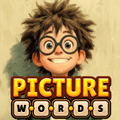
It runs as an HTML5 game, so the images and the letter grid load straight into a browser tab with no download and no installer.
What is Plaatjes Woorden?
This is a picture-to-word puzzle where the answers are Dutch. You see an image, work out the Dutch word for it, and connect the available letters to spell that word.
The language choice changes the difficulty in a specific way. Dutch spelling is largely phonetic and regular, which helps, but it also uses digraphs such as ij, oe, eu and ui that do not map neatly onto how a non-native speaker hears the word. Those combinations are where most wrong answers happen.
Dutch also builds compound nouns freely, joining several words into one. A picture that would be two words in English is frequently one long Dutch word, which is why the letter count matters more here than in the English edition.
How to play Plaatjes Woorden
Look at the image, identify the Dutch word it represents, and connect the letters to create it. The letters you need are provided, so the task is knowing the word and its spelling rather than typing anything. Complete the word to move on to the next image. If the letter set is longer than you expected, the answer is probably a compound noun — think of the picture as two ideas joined together rather than one.
| Element | What it does |
|---|---|
| The image | The clue you must name in Dutch |
| Letter set | Contains the letters needed for the answer |
| Connecting letters | Spells out your answer in order |
| Long letter counts | Often signal a Dutch compound noun |
| Correct word | Advances you to the next image |
Core Plaatjes Woorden mechanics
Digraphs are single sounds. When you hear one sound, it may need two letters. The ij, oe, eu and ui combinations are the usual culprits.
Compounds are one word. When the letter count looks long, the answer is probably two concepts joined without a space, as Dutch does routinely.
Spelling is produced, not chosen. When you connect letters, recognition is not enough. You have to know the written form.
The letter set constrains the answer. When a picture could have two names, the letters available decide which one is wanted.
Tactics that work in Plaatjes Woorden
Check for digraphs first. Before spelling, ask whether the word contains ij, oe, eu, ui or aa. These combinations are the most common source of errors for anyone whose first language is not Dutch, and spotting them in the letter set often confirms the answer.
Let the letter count tell you about compounds. Dutch joins nouns together where English uses two words, so an unexpectedly long set usually means a compound. Thinking of the picture as two joined ideas is faster than searching for one long word.
Say the word aloud. Dutch spelling is fairly phonetic, so pronouncing the word helps you break it into letters. This works considerably better in Dutch than it would in English, where spelling and sound diverge more.
Look for the everyday word. When a picture could be named several ways, the common household term is almost always the intended one. Games in this format are built around basic vocabulary rather than precise or formal terms.
Watch the double vowels. Dutch uses doubled vowels to mark length, and it is easy to spell a word with one where two are needed. If your answer is one letter short, a doubled vowel is the most likely omission.
Practise little and often. Vocabulary sticks far better through short repeated sessions than one long one. Ten minutes a few times a week does more for Dutch spelling than an hour in a single sitting.
Plaatjes Woorden features at a glance
- Dutch-language answers, making this a genuine vocabulary and spelling exercise
- Image clues answered by connecting letters rather than by multiple choice
- Letter counts that hint at compound nouns, a common Dutch construction
- No typing required, which suits younger learners
- No timer, so it works as a learning tool as well as a game
- Free word game in the browser with no download required
Games similar to Plaatjes Woorden
| Game | Why try it |
|---|---|
| Picture Words | The same game with English words. |
| Bilder Wörter | The same game with German words. |
| Imagen Palavra | The same game with Portuguese words. |
| Memory Flip | A recall exercise with no language involved. |
| Hidden Spots - City | Visual attention practice in a different form. |
Plaatjes Woorden FAQ
Is it free to play? Yes. Plaatjes Woorden runs in the browser at no cost, with no installer and no account. Free browser game titles distributed this way normally carry advertising placements around the frame rather than charging for levels.
What language are the answers in? Dutch. Separate editions of this game exist for English, German and Portuguese, so check you are on the version matching the language you want to practise.
Do I need to speak Dutch already? Some vocabulary helps, but the letter set narrows the possibilities considerably. Beginners can often work out an answer from the image and the letters available together.
Why are some answers so long? Because Dutch forms compound nouns by joining words directly. A picture that needs two words in English frequently becomes a single longer word in Dutch.
Is there a time limit? None is indicated, which is what makes it usable as a learning exercise rather than a test. You can take as long as you need to work a word out.
Do I need to install anything? No. It is an HTML5 game with no download, so it loads in an ordinary browser tab without a plugin, a store account or a separate client.
Plaatjes Woorden technical requirements
Delivered as an HTML5 title, it runs in any current browser with standards support: Chrome, Firefox, Edge, Safari and their mobile equivalents. Requirements are minimal because nothing animates continuously, and connecting letters with a finger works as naturally as with a mouse. There is no download and nothing to install.
Final verdict on Plaatjes Woorden
The strength of Plaatjes Woorden is that it targets exactly the parts of Dutch that are hard to produce from memory: the digraphs and the compound nouns. Because you spell rather than select, it tests knowledge properly instead of rewarding recognition. The limit of Plaatjes Woorden is scope — no progression, no scoring and no difficulty settings. It suits Dutch learners, children practising spelling, and anyone who wants a low-pressure vocabulary drill.
▶ Play Plaatjes Woorden free — no download, just look and spell
Why players keep coming back to Plaatjes Woorden
Plaatjes Woorden rewards patience more than speed, which is a large part of why Plaatjes Woorden keeps pulling players back.
A single round of Plaatjes Woorden is short, so Plaatjes Woorden fits into the gaps of a day rather than demanding a whole evening.
Improvement in Plaatjes Woorden is visible from one attempt to the next, and that visible progress is what makes Plaatjes Woorden worth reopening.
Because Plaatjes Woorden loads in a browser tab, starting Plaatjes Woorden again costs nothing but a click.
Nothing in Plaatjes Woorden has to be learned twice, which is why coming back to Plaatjes Woorden after a week still feels comfortable.
Every mistake in Plaatjes Woorden is traceable to a decision you made, and that honesty is unusual enough to keep Plaatjes Woorden interesting.
The low barrier to entry is most of what Plaatjes Woorden offers, and it is why Plaatjes Woorden suits players who dislike long tutorials.
 +10
 +10
 +10
 +10
 +10
 +10
 +10
 +10
 +10
 +10
 +10
 +10