About Picture Words
See the picture, find the word, drag a line through the letters that spell it — Picture Words is a vocabulary puzzle where the clue is an image and the answer is spelled out by hand.
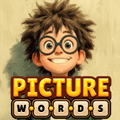
It runs as an HTML5 game, so the images and the letter grid load straight into a browser tab with no download and no installer.
What is Picture Words?
This is a picture-to-word game. An image appears, and you create the English word that represents it by connecting letters together.
Two things are being tested at once, which is what gives it more depth than it first appears. The first is recognition: knowing what the picture shows. The second is spelling: producing the word letter by letter rather than choosing it from a list.
That combination makes it genuinely useful as a vocabulary exercise. Recognising a word when you see it is a much weaker form of knowing it than being able to spell it from scratch, and this format only accepts the stronger one.
How to play Picture Words
Look at the image, work out the English word it represents, and connect the letters to create that word. The letters are provided, so the challenge is knowing which ones you need and in what order rather than typing anything. Complete the word to move to the next image. If you know what the picture shows but not the spelling, count the letters available — the number given is usually a strong hint about which form of the word is wanted.
| Element | What it does |
|---|---|
| The image | The clue you must identify |
| Letter set | Contains the letters needed for the answer |
| Connecting letters | Spells out your answer in order |
| Correct word | Advances you to the next image |
| Letter count | Hints at which form of the word is expected |
Core Picture Words mechanics
Two skills, one answer. When you get stuck, work out whether the problem is the picture or the spelling. They need different fixes.
The letters are a constraint and a clue. When you are unsure, read what is available. An unusual letter in the set narrows the possibilities immediately.
Order is part of the answer. When you connect letters, you are spelling rather than selecting. Recognition alone is not enough here.
Images can be ambiguous. When a picture could be two words, the letter set decides which one. Let the letters break the tie.
Tactics that work in Picture Words
Read the letters before naming the picture. Scan the available letters first, then look at the image. Seeing an unusual letter such as a Q or a Z immediately narrows what the answer can be, and often identifies it outright.
Count the spaces. The number of letters required tells you a great deal, including whether a plural or a longer synonym is wanted. A four-letter answer and a seven-letter answer for the same picture are entirely different words.
Start with the consonants. Identify the consonant skeleton of the word you have in mind and check it against the letter set. Consonants carry more identifying information than vowels and confirm or eliminate a guess faster.
Consider the simpler word. When a picture could be described several ways, the more common everyday term is usually the intended one. Games of this type are built around basic vocabulary rather than precise terminology.
Say the word aloud. Speaking it helps you separate the sounds into letters, which is exactly what the connect-the-letters mechanic asks for. This is especially effective for anyone learning English rather than spelling it natively.
Play regularly rather than at length. Vocabulary retention responds far better to short repeated sessions than to one long one. Ten minutes a few times a week does more for spelling than an hour in a single sitting.
Picture Words features at a glance
- Image clues answered by spelling rather than by multiple choice
- Connect-the-letters input that works with a mouse or a finger
- Recognition and spelling tested together in a single answer
- A letter set that doubles as a hint about the expected word
- No timer, so it works as a learning exercise as well as a game
- Free word game in the browser with no download required
Games similar to Picture Words
| Game | Why try it |
|---|---|
| Plaatjes Woorden | The same game with Dutch words. |
| Bilder Wörter | The same game with German words. |
| Imagen Palavra | The same game with Portuguese words. |
| Memory Flip | A recall exercise in a different register. |
| Find the Odd One Out | Visual attention without the vocabulary. |
Picture Words FAQ
Is it free to play? Yes. Picture Words runs in the browser at no cost, with no installer and no account. Free browser game titles distributed this way normally carry advertising placements around the frame rather than charging for levels.
What language are the answers in? English. Versions of this game exist for other languages as separate titles, so make sure you are playing the one matching the language you want to practise.
Do I type the word? No. You connect the provided letters in order, which means spelling is tested but typing accuracy is not — a useful distinction for younger players.
Is it good for learning English? The format suits vocabulary practice well, because producing a spelling from an image is a stronger test of knowledge than recognising a word from a list.
Is there a time limit? None is indicated, which is what makes it usable as a learning exercise. There is no pressure to answer before you have worked the word out properly.
Do I need to install anything? No. It is an HTML5 game with no download, so it loads in an ordinary browser tab without a plugin, a store account or a separate client.
Picture Words technical requirements
Delivered as an HTML5 title, it runs in any current browser with standards support: Chrome, Firefox, Edge, Safari and their mobile equivalents. Requirements are minimal because nothing animates continuously, and connecting letters with a finger works as naturally as with a mouse. There is no download and nothing to install.
Final verdict on Picture Words
The strength of Picture Words is that it asks for production rather than recognition. Spelling a word out from an image is a real test of whether you know it, and the letter set gives just enough help to keep that fair rather than frustrating. The limit of Picture Words is scope: there is no progression system, no scoring depth and nothing to unlock. It suits short regular sessions, younger players and anyone practising English vocabulary.
▶ Play Picture Words free — no download, just look and spell
Why players keep coming back to Picture Words
Picture Words rewards patience more than speed, which is a large part of why Picture Words keeps pulling players back.
A single round of Picture Words is short, so Picture Words fits into the gaps of a day rather than demanding a whole evening.
Improvement in Picture Words is visible from one attempt to the next, and that visible progress is what makes Picture Words worth reopening.
Because Picture Words loads in a browser tab, starting Picture Words again costs nothing but a click.
Nothing in Picture Words has to be learned twice, which is why coming back to Picture Words after a week still feels comfortable.
Every mistake in Picture Words is traceable to a decision you made, and that honesty is unusual enough to keep Picture Words interesting.
The low barrier to entry is most of what Picture Words offers, and it is why Picture Words suits players who dislike long tutorials.
 +10
 +10
 +10
 +10
 +10
 +10
 +10
 +10
 +10
 +10
 +10
 +10